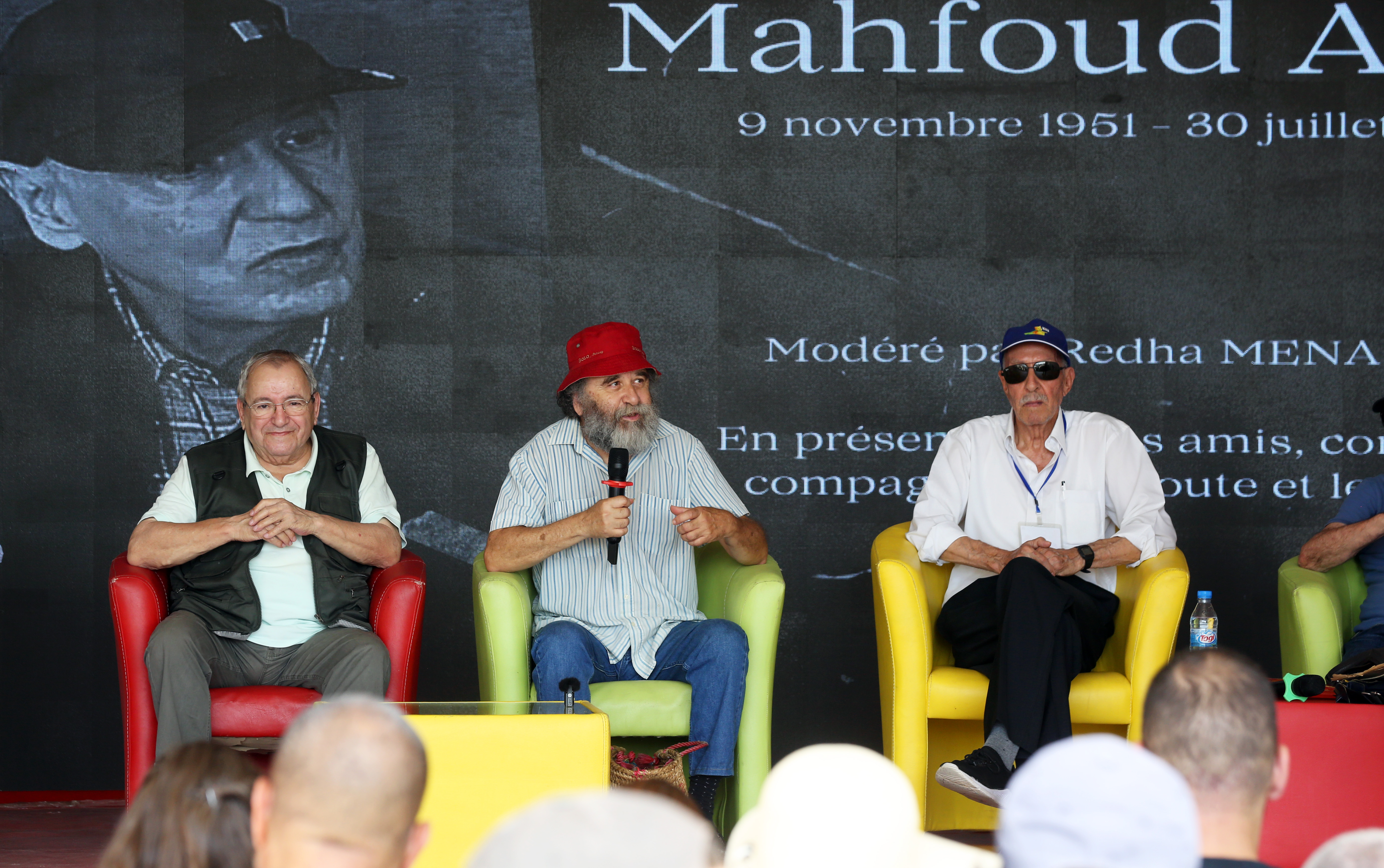
The tribute paid to Mahfoud Aïder at FIBDA on Saturday, October 3, 2026, was far from a formal, solemn ceremony. Around his drawings, characters and newspapers, those who knew him spoke above all of the man behind the artist: a companion, a tireless worker and a passionate lover of comics, caricature, cinema, music and stories. From M'quidech to El Manchar, several generations of cartoonists and journalists paid tribute to the man who was part of some of the major chapters in the history of Algerian comics.
The tribute was initially intended to retrace the artist's career through its major stages. But the testimonies quickly took a different direction, turning instead to memories, encounters and anecdotes that offered a glimpse of Mahfoud Aïder behind the cartoonist.
Reda Menassel said he had grown up with Aïder's world, whose characters had accompanied him throughout his childhood. "I learned to decipher and to read through these comics," he recalled, referring in particular to one of the characters created by the artist. He also shared an anecdote dating back to 2015, when he contacted Aïder to take part in a short film made without funding.
"He didn't know me. He took my call. I convinced him in two minutes," he recalled. Aïder agreed to take part in the shoot, which was scheduled in the middle of the night, around 2 or 3 a.m. "He came, waited, filmed his scene brilliantly and left," he added, seeing the episode as an illustration of the artist's availability and willingness to help.
"Aïder is Aïder"
Speaking next, Lazhari Labter first recalled that, from the early days of his career, Mahfoud Aïder had been surrounded by several major figures in Algerian comics. Among the screenwriters who played a role in the M'quidech adventure, he notably mentioned Boukhalfa Amazit and Lamine Merbah.
"I didn't have the chance to work at M'quidech; I'm not a cartoonist. But I read everything by Aïder," said Lazhari Labter, who devoted an anthology to M'quidech and is particularly familiar with this period in the history of Algerian comics.
Above all, he highlighted Aïder's constant presence throughout the various chapters of Algeria's comics scene. "What is extraordinary about Aïder is that he was part of every adventure in comics in Algeria," he said. According to him, there was practically "not a single magazine, not a single newspaper where he did not contribute, where he did not leave his mark."
Lazhari Labter also stressed the artist's versatility. At a time when many cartoonists were particularly well trained in drawing but faced greater difficulties when it came to writing scripts, Aïder, in his view, belonged to the category of "complete artists."
"He had an immense general culture, he was interested in many forms of art — cinema, comics, music and more," he explained. He was also familiar with the tales and stories of Algerian, Arab and world heritage. "Aïder is Aïder; he is practically one of a kind," Lazhari Labter concluded.
Slimane Zeghidour's Companion on the Journey
For writer and researcher Slimane Zeghidour, the memory of Aïder is first and foremost that of a friendship that deeply shaped his own life. "Aïder is a part of my life. And a crucial, very important part," he said.
Zeghidour recalled joining the Société nationale d'édition et de diffusion (SNED) at the end of the 1960s. He was supposed to resume his studies and prepare to enter university. His father wanted him to become a doctor or an engineer. But the few months he spent at SNED were to change his plans. "I enjoyed those three summer months so much, and I had become close to Aïder, that I told myself: I'm going to stay with them," he recalled.
Those years were also a time of discovering Algiers' cultural and cosmopolitan life. With Aïder, Boukhalfa Amazit, Slim and other artists, he frequented cafés and meeting places across the capital. "I, a little country boy from the Babors who lived in Birmandreis, found myself in a kind of United Nations," he said, referring to the presence of Brazilian, Argentine, Chilean and other exiles.
For Zeghidour, Aïder was therefore a witness to a profound change in his life. "For me, Aïder is my companion on the journey, the witness to my inner transformation and to my shift from the world of studies into the world of work," he said.
"A Flower of the Asphalt"
Boukhalfa Amazit, for his part, preferred to speak about the man rather than turn him into an inaccessible figure. "Aïder was the kid from Champ-de-Manœuvre, and he remained that way all his life," he said.
He explained that Aïder's characters were often extensions of his own personality. "Aïder's characters are Aïder; they are himself," he said. His passion for CRB, his interest in history, his love of games and his everyday surroundings directly fed into his work.
Boukhalfa Amazit also spoke about the artist's education, which he described as that of a "flower of the asphalt." "He learned in the street, with his friends, in his neighborhood, through what he experienced every day," he explained.
This closeness to everyday life was also reflected in his writing. Quoting a text he himself had written about Aïder, Boukhalfa Amazit recalled how the cartoonist joined M'quidech with an almost military sense of purpose. "He therefore joined M'quidech as one joins a regiment, convinced that one day he would become a general," he recalled.
A Tireless Worker
All the testimonies converged on one point: Aïder worked relentlessly. Another speaker, who had known him while he was still in high school, recalled that every time he visited SNED, he would find Aïder bent over his drawing board, pen and Indian ink in hand.
"I would find Aïder bent over his drawing board with his pen and Indian ink, constantly working," he recalled.
He particularly remembered the long sessions during which the artist tirelessly sketched his characters, including The Adventures of Kouider. "The one thing I remember very clearly is that he was an incredibly hard worker," he said.
The same passion for work came up in Boukhalfa Amazit's testimony. According to him, Aïder practically never stopped producing. Whenever he left a newspaper or completed an album, he immediately moved on to another project.
El Manchar, Another Great Adventure
Mahfoud Aïder's story is also inseparable from El Manchar, the satirical newspaper to which he contributed and which he later headed.
Boukhalfa Amazit recounted an anecdote illustrating the newspaper's influence at the time. During an interview with President Chadli Bendjedid, Slimane Zeghidour noticed several issues of El Manchar on the presidential desk. "As soon as it comes out, they bring it to him, as soon as it comes out," a presidential official reportedly told him.
The newspaper's caricatures and articles did not spare those in power. But, according to the testimony given during the tribute, Chadli Bendjedid appreciated self-deprecating humor and followed the jokes directed at him.
One of the speakers recalled that El Manchar also gave several young cartoonists an opportunity to take their first professional steps.
He recalled meeting Aïder again in Algiers in the early 1990s, after working as a doctor in Jijel. Aïder then offered him the opportunity to contribute to the newspaper. "Since you were part of the M'quidech team, if you'd like to make a little extra money, you can contribute to El Manchar," he suggested. He would produce small caricatures and receive an envelope in return for his contributions.
The El Manchar adventure also led Aïder and several Algerian cartoonists to take part, in 2003, in an international gathering in Saint-Just-le-Martel, France, as part of the Year of Algeria in France.
The event brought together press cartoonists from several countries. "We met people from a huge number of nationalities," one of the participants recalled.
He also spoke about exchanges with two Israeli press cartoonists who, according to his account, were campaigning in their country at the time for Palestinian rights.
This international experience also reflected the openness of this generation of cartoonists, for whom caricature and comics served as spaces for encounters and dialogue.
From Comics to Caricature and Journalism
Ahmed Haroun, the artist behind the first cover of El Manchar, recalled the long-standing collaboration that united him with Aïder. "Aïder is more than a friend; he is a colleague. We have always worked together," he said.
The two men produced numerous illustrations together and worked in the print press. Aïder also turned to caricature and writing. "He does comics, he writes the scripts, and he also went on to write," Ahmed Haroun noted, also recalling his journalistic work at El Manchar. As the newspaper's editor-in-chief, Aïder notably wrote its editorials.
Haroun also spoke about his final exchanges with the artist, just days before his death. Aïder had told him that he was not feeling well and would not sit on the FIBDA jury as he had in previous years. "He encouraged me and told me, 'No, you should still take part,'" Haroun recalled. Despite his condition, Aïder continued to think about the festival and his work.
"Aïder Is in My Mind"
Slim, whose real name is Menouar Merabtène, a press cartoonist, also gave an emotional testimony. He recalled seeing Aïder a few weeks before his death. "A month earlier, I had seen him; we had some coffee. He told me a little about how he was doing," he recalled. The two men were supposed to meet again in June, after Aïder had told him he would be back. "And then I learned from the press that Aïder was gone," he continued. "He was a great cartoonist and a great friend who left us unexpectedly. And wherever he is, we salute him."
Slim also holds a very personal memory of the artist. "He gave me a gift two or three years ago. He made me a large drawing featuring Bouzid and his characters," he recalled. The drawing now hangs in his home. "It is a picture that is in my house and that I see every morning. And so Aïder is in my mind," he said.
Returning to the El Manchar adventure, Slim highlighted the originality of the project, which brought together cartoonists, caricaturists and writers drawn to political humor in the same newspaper. "For me, it was a great idea. For the first time, there was a newspaper that brought together cartoonists and, at the same time, humorists or people who enjoyed writing about politics, but in a playful way," he explained.
He said he had enthusiastically welcomed Aïder's proposal. "I was happy to see all my friends again and to contribute," he said. But the newspaper's adventure would soon have to contend with changes in the political context and the difficulties that came with them.
Slim also recalled that spaces where cartoonists and humorists could express themselves were rare in Algeria. "Apart from advertising, there are very few newspapers or spaces where you can express yourself, have a laugh, draw," he stressed. For him, the emergence of El Manchar therefore represented a genuine opportunity to keep this freedom of expression alive and to reconnect with a community of cartoonists and humorists.